

Best Industrialized Countries is a term used by political scientists and economists to describe a country whose level of economic development ranks it anywhere between developing and highly developed countries. Specialists also know them as “newly industrializing economies” or “progressive developing countries.” These nations have moved away from an agriculture-based economy toward a more industrialized, urban economy.
A newly industrialized country (or NIC) is an evolving economy that has transitioned from being based on agriculture or extracting raw materials to being primarily based on producing manufactured goods. These nations have taken necessary steps toward industrialization and consider developed economies at some point soon. Sometimes, this economy refers to as creating bazaars.
Table of Contents
What Defines an Industrialized Country
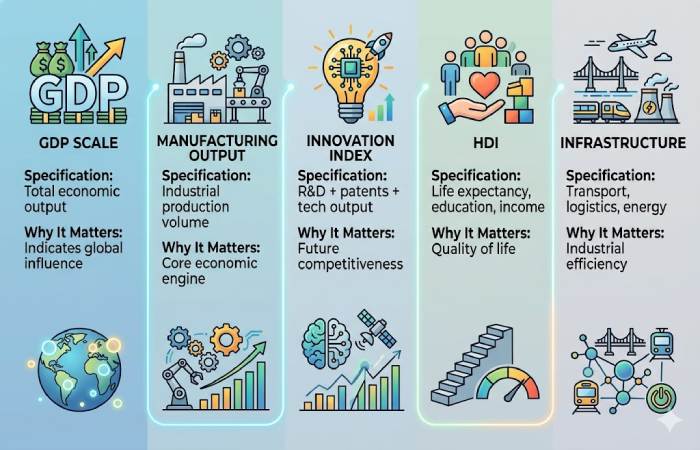
An industrialized country typically meets three global benchmarks:
- Economic maturity: High GDP and diversified economy
- Industrial capacity: Strong manufacturing and export systems
- Human development: High HDI and innovation output
According to the World Intellectual Property Organization Global Innovation Index 2025, countries such as Switzerland, the USA, and South Korea dominate the innovation rankings, with scores above 60, indicating highly advanced ecosystems.
Industrialization “Specification Framework”
Top 10 Best Industrialized Countries
United States
The United States remains the most balanced industrialized country globally—combining advanced manufacturing with tech dominance.
| Category | Factor | Details |
| Overview | Positioning | Most balanced industrialized country globally |
| Economy | GDP | ~$27 trillion |
| Industries | Key Sectors | AI, aerospace, biotech |
| Innovation | Global Rank | Top 3 globally |
| Infrastructure | Development Level | Highly developed |
| Costs (Prices) | Rent (City) | $1,500–$3,500/month |
| Industrial Labor | High | |
| Electricity | Moderate | |
| Trend / Outlook | Industrial Shift | Moving toward AI-driven and robotics-based ecosystems |
The U.S. is transitioning from traditional manufacturing to high-value industrial ecosystems (AI + robotics).
Germany
Germany is widely considered the world’s most efficient manufacturing economy.
| Category | Factor | Details |
| Specifications | Key Sector | Automotive, machinery |
| Export Rank | Top 3 globally | |
| Innovation Score | ~55+ | |
| Costs (Prices) | Rent | €800–€1,800/month |
| Energy | High (post-energy crisis) | |
| Labor | High but skilled |
Germany excels in precision engineering (Mittelstand model)—a key differentiator vs. the U.S.
Japan
Japan leads in automation and robotics integration.
| Category | Factor | Details |
| Specifications | Core Strength | Robotics & electronics |
| Productivity | Extremely high | |
| Infrastructure | World-class | |
| Costs (Prices) | Rent | Moderate–high |
| Labor | High | |
| Tech Investment | Very high |
Japan is less about scale and more about efficiency and automation leadership.
China
China remains the largest industrial producer globally.
| Category | Factor | Details |
| Specifications | Core Strength | Robotics & electronics |
| Productivity | Extremely high | |
| Infrastructure | World-class | |
| Costs (Prices) | Rent | Moderate–high |
| Labor | High | |
| Tech Investment | Very high |
China is shifting from low-cost manufacturing → high-tech industrialization.
South Korea
South Korea dominates electronics and semiconductors.
| Category | Factor | Details |
| Specifications | Innovation Rank | Top 5 globally |
| Key Industry | Semiconductors | |
| Export Dependency | High | |
| Costs (Prices) | Rent | Moderate |
| Labor | High | |
| Tech R&D | Extremely high |
United Kingdom
| Category | Factor | Details |
| Specifications | Core Strength | Finance, aerospace, pharmaceuticals |
| Productivity | High (service-driven economy) | |
| Infrastructure | Highly developed | |
| Costs (Prices) | Rent | £1,000–£2,500/month |
| Labor | High | |
| Tech Investment | High |
The UK combines strong financial services with high-value industrial sectors, making it ideal for hybrid careers.
France
| Category | Factor | Details |
| Specifications | Core Strength | Aerospace, luxury goods, energy |
| Productivity | High | |
| Infrastructure | World-class | |
| Costs (Prices) | Rent | €900–€2,000/month |
| Labor | High | |
| Tech Investment | High |
France offers a strong balance between industrial capability and quality of life.
Canada
| Category | Factor | Details |
| Specifications | Core Strength | Energy, mining, manufacturing |
| Productivity | High | |
| Infrastructure | Highly developed | |
| Costs (Prices) | Rent | CAD 1,200–2,500/month |
| Labor | High | |
| Tech Investment | High |
Canada provides stability and resource-driven industrial strength with excellent living standards.
Italy
| Category | Factor | Details |
| Specifications | Core Strength | Fashion, machinery, design manufacturing |
| Productivity | Medium–high | |
| Infrastructure | Developed | |
| Costs (Prices) | Rent | €700–€1,800/month |
| Labor | Medium | |
| Tech Investment | Moderate |
Italy excels in niche, high-quality manufacturing, especially in luxury and design sectors.
Switzerland
| Category | Factor | Details |
| Specifications | Core Strength | Pharmaceuticals, finance, precision manufacturing |
| Productivity | Extremely high | |
| Infrastructure | World-class | |
| Costs (Prices) | Rent | CHF 1,500–3,500/month |
| Labor | Very high | |
| Tech Investment | Extremely high |
Switzerland leads globally in innovation efficiency, delivering high output despite its small size.
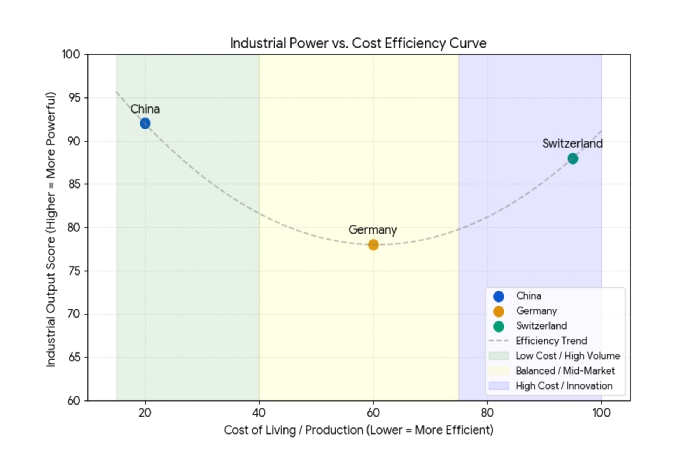
Industrial Strength vs Cost vs Quality
| Country | Industrial Strength | Cost of Living | Innovation | Quality of Life |
| USA | Very High | High | Very High | High |
| Germany | Very High | High | High | Very High |
| Japan | High | High | Very High | Very High |
| China | Extremely High | Medium | Medium-High | Medium |
| South Korea | High | Medium-High | Very High | High |
| Switzerland | Medium | Very High | #1 globally | Extremely High |
Alternatives: Emerging Industrial Countries
| Country | Why It Matters |
| India | Fastest growth + manufacturing push |
| Vietnam | China alternative |
| Brazil | Resource + industry mix |
Pros and Cons
| Pros | Cons |
| High salaries | High living costs |
| Advanced infrastructure | Competitive markets |
| Strong healthcare & education | Regulatory complexity |
| Innovation ecosystems | Inequality issues |
Review
Most blogs treat industrialized countries as a static list—but that’s outdated.
Real Insight:
- The USA dominates innovation ecosystems
- Germany leads in manufacturing quality
- China leads in scale
- Switzerland leads in innovation efficiency
According to OECD insights, productivity growth has slowed globally, meaning future leaders will be those who combine innovation + efficiency, not just output.
FAQs
Which country is the most industrialized?
China leads in manufacturing output, while the USA leads overall economy and innovation.
Which is best for jobs?
Germany and the USA offer the best industrial employment ecosystems.
Which has the lowest cost?
China and emerging markets like Vietnam offer lower production costs.
Which has the best quality of life?
Switzerland and Canada consistently rank highest.
Are industrialized countries still growing?
Yes, but growth is shifting toward automation, AI, and green manufacturing.
Conclusion
There is no single “best” industrialized country in absolute terms—only the one that best aligns with your goals. The United States leads in innovation and high-income opportunities, Germany excels in precision manufacturing and export strength, and China dominates global production scale. Meanwhile, countries like Switzerland and Canada offer an exceptional quality of life with stable, high-value industries.
As global industry shifts toward automation, sustainability, and digital transformation, the smartest approach is to evaluate countries based on a mix of industrial strength, cost structures, innovation capacity, and long-term growth potential rather than relying on rankings alone.