Exchange rates are not just currency prices — they are expectation-driven market signals shaped by policy, capital flows, and provider markups. Understanding the mechanics behind them leads to better financial decisions.
Most people treat exchange rates like a lookup number and assume that’s the real cost of money. It isn’t. The visible rate is only the surface layer. Underneath are interbank markets, spreads, conversion pipelines, and policy expectations that shift value before headlines appear. This guide gives you a practical, decision-first view: how rates are formed, how to exchange money smartly, what it costs, which providers specialize in FX, how geography affects value, and how exchange systems evolved.
Table of Contents
What Exchange Rates Actually Represent
An exchange rate is the live price at which one currency can be traded for another — but operationally, it is also:
-
A forecast of relative economic strength
-
A yield competition signal
-
A capital flow tracker
-
A policy credibility score
Policy signals from institutions such as the Federal Reserve and the European Central Bank strongly influence rate direction through interest rate expectations and liquidity policy. Global outlook frameworks from the International Monetary Fund are widely referenced because forward expectations move currencies more than backward data.
Exchange Rate Types
| Type | How It Works | Who Sets Price | Stability | Flexibility | Example Pattern |
|---|---|---|---|---|---|
| Floating | Market supply/demand | Market | Medium | High | Major developed economies |
| Managed Float | Market + intervention | Market + central bank | Medium-high | Medium | Many emerging markets |
| Fixed / Pegged | Currency tied to anchor | Government | High (until stress) | Low | Dollar pegs |
How Exchange Rates Are Formed (Conversion Pipeline)
Rule: Every step away from interbank adds cost.
| Layer | Who Operates Here | What Happens | Impact on You |
|---|---|---|---|
| Interbank Market | Global banks | Raw FX trading | Best possible rate |
| Liquidity Providers | Prime brokers | Quote distribution | Small spread added |
| Banks / Fintechs | Retail providers | Margin added | Wider spread |
| Consumer Checkout | Final platform | FX + fee combo | Your real cost |
Exchange rate movement over time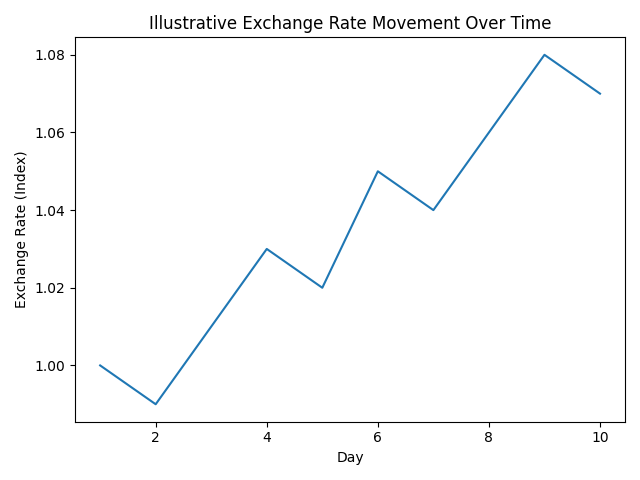
Top Currency Converter Apps
| App | Best For | Key Features | Platforms | Cost Model | Notable Strength |
|---|---|---|---|---|---|
| XE Currency | Travel & everyday rate checks | Live exchange rates, historical charts, rate alerts, offline mode | iOS, Android | Free | Very widely trusted rate reference |
| OANDA Currency Converter | Professional & analytical users | Institutional-grade rates, historical data, customizable spreads | iOS, Android, Web | Free tools + paid pro services | Strong for deeper FX analysis |
| Wise | Transfers + real conversion rates | Mid-market rates, transparent fees, multi-currency wallet | iOS, Android, Web | Free app; fees on transfers | Best for actually exchanging money |
| Currency Converter Plus Live | Quick conversions | Fast calculator, charts, offline support, metals & crypto | iOS, Android | Free + ads / premium | Very beginner-friendly |
| Currency Converter Worldwide | Simple use | 150+ currencies, offline rates, lightweight | iOS, Android | Free | Clean, no-clutter interface |
| Live Currency Converter | Broad coverage | 200+ currencies, offline mode, trend data | iOS, Android | Free | Large currency database |
| Currency – Multi Converter | Frequent converters | Widgets, crypto support, multi-pair view | iOS, Android | Free + premium | Good dashboard-style layout |
How to Exchange Currency – Method-by-Method Guide
Physical Cash Exchange
Best for: small travel amounts
Worst for: value efficiency
| Feature | Details |
|---|---|
| Where | Airports, kiosks, border exchanges |
| Typical Spread | Very high |
| Speed | Instant |
| Transparency | Low |
| Best Use | Emergency travel cash |
| Risk | Worst rates in market |
Bank Conversion
Best for: convenience
Weak for: price
| Feature | Details |
|---|---|
| Where | Retail banks |
| Typical Spread | High |
| Fees | Sometimes hidden |
| Speed | Same day |
| Best Use | Small transfers |
| Risk | Quiet margin stacking |
Card Network Conversion
| Feature | Details |
|---|---|
| Where | Credit/debit cards |
| Typical Spread | Medium |
| Fees | Issuer dependent |
| Speed | Automatic |
| Best Use | Travel spending |
| Risk | Dynamic currency conversion traps |
FX Specialist Providers
Best for: large transfers and business use
| Feature | Details |
|---|---|
| Where | Dedicated FX firms |
| Typical Spread | Low |
| Fees | Transparent |
| Speed | 1–2 days |
| Best Use | $1k+ equivalent transfers |
| Risk | Requires account setup |
Common specialist categories:
| Specialist Type | Typical Users | Strength |
|---|---|---|
| Retail FX firms | Individuals | Better rates |
| Business FX desks | SMEs | Hedging tools |
| Payment platforms | Freelancers | Multi-currency wallets |
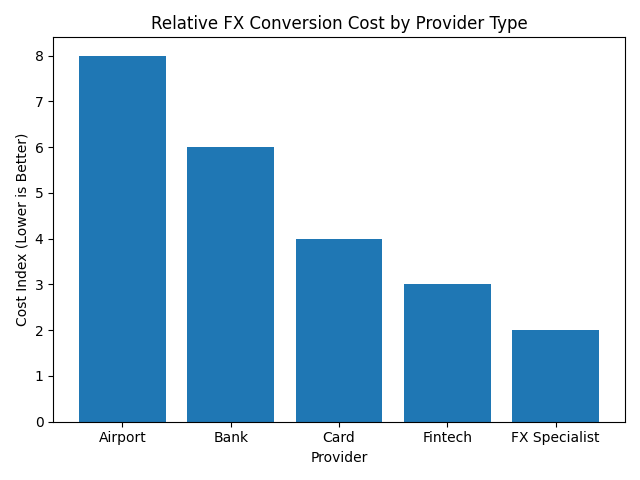
Pricing Structure Comparison
| Provider Type | Advertised Fee | Hidden Spread | Total Cost Pattern |
|---|---|---|---|
| Airport Exchange | Visible | Very high | Worst |
| Retail Bank | Low | High | Expensive |
| Card FX | None | Medium | Moderate |
| FX Specialist | Low | Low | Best value |
| Fintech Wallet | Low | Low-medium | Good value |
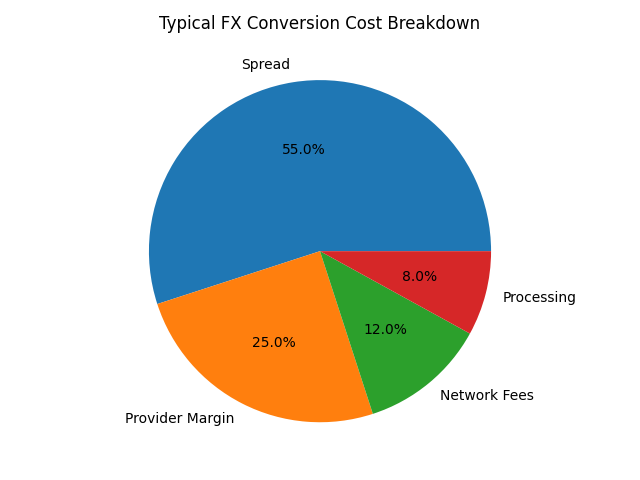
Example Conversion Cost Table
| Method | Public Rate | Offered Rate | Result on 5,000 Units |
|---|---|---|---|
| Interbank | 1.000 | — | 5,000 |
| Bank | 1.000 | 0.955 | 4,775 |
| Card | 1.000 | 0.975 | 4,875 |
| Specialist | 1.000 | 0.992 | 4,960 |
Specialist Provider Categories by Region
| Region | Specialist Type Common | Typical Strength |
|---|---|---|
| North America | Business FX firms | Large transfers |
| UK & EU | Multi-currency fintech | Travel + freelance |
| Asia-Pacific | Cross-border payment firms | Trade settlement |
| Middle East | Remittance specialists | Worker transfers |
| Africa | Mobile FX platforms | Access + speed |
Reviews: What Users Commonly Praise vs Complain About
| Provider Type | Positive Review Themes | Negative Review Themes |
|---|---|---|
| Banks | Trust, simplicity | Poor rates |
| Fintech FX apps | Transparency | Support delays |
| FX specialists | Strong rates | Onboarding friction |
| Airport kiosks | Convenience | Extremely costly |
History of Exchange Rates
| Period | System | Key Feature |
|---|---|---|
| Pre-1900 | Metal standards | Gold/silver backing |
| 1944–1971 | Bretton Woods | USD anchored to gold |
| Post-1971 | Floating era | Market pricing |
| 1990s+ | Liberalization | High capital mobility |
| 2000s+ | Managed hybrids | Intervention models |
Key shift: after the Bretton Woods system ended, most major currencies moved to floating exchange rates, where markets — not fixed pegs — determine value.
What Actually Moves Exchange Rates Day to Day
| Driver | Mechanism | Speed of Impact |
|---|---|---|
| Interest rate expectations | Yield flows | Fast |
| Inflation outlook | Purchasing power | Medium |
| Risk sentiment | Capital safety moves | Very fast |
| Trade balance | Currency demand | Slow |
| Political stability | Confidence | Fast |
Scenario Table: News vs Currency Reaction
| News Type | Rate Impact Likely? | Why |
|---|---|---|
| Election speech | Low | No yield change |
| Rate guidance shift | High | Yield path changes |
| Inflation surprise | Medium-high | Policy expectation shifts |
| Minor data release | Low | Already priced |
Geographic Differences in Exchange Rate Experience
| Geography | Typical Consumer FX Experience |
|---|---|
| US | Bank spreads higher, card use dominant |
| UK | Strong fintech FX competition |
| EU | Transparent disclosures improving |
| Asia | App-based multi-currency growth |
| Africa | Mobile-first FX access |
Regulation and competition shape pricing transparency more than currency strength does.
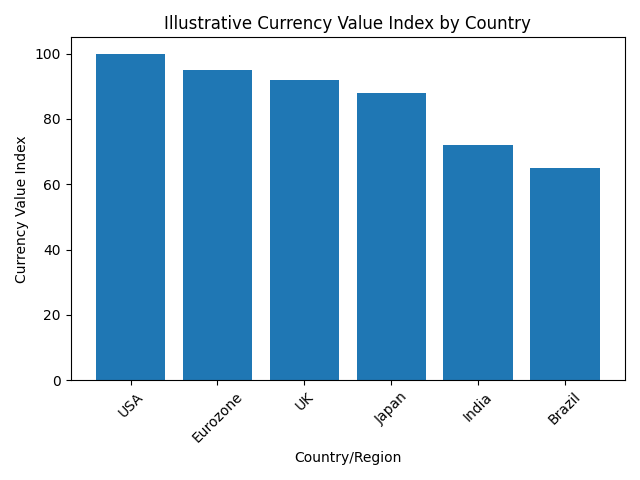
Comparison of Currency Value by Country
Illustrative — shows how exchange rates affect perceived cost levels.
| Country | Strong Currency Effect | Weak Currency Effect |
|---|---|---|
| High-income | Imports cheaper | Exports harder |
| Export-led | Exports competitive | Imports costly |
| Tourism-driven | Travel expensive | Travel attractive |
| Import-dependent | Inflation risk | Cost pressure |
Practical FX Strategy by Use Case
Travel Strategy
| Need | Best Method | Avoid |
|---|---|---|
| Card spending | Low-FX card | Merchant conversion |
| Cash backup | Bank ATM abroad | Airport exchange |
Freelancer Strategy
| Pattern | Better Approach |
|---|---|
| Foreign income | Hold same currency wallet |
| Irregular payments | Batch convert |
| Large invoices | Use specialist FX |
Small Business Strategy
| Exposure | Tool |
|---|---|
| Known future invoice | Forward contract |
| Mixed currency costs | Natural hedge |
| Volatile margins | Split conversions |
Common Exchange Rate Myths vs Reality
| Myth | Reality |
|---|---|
| Best rate wins always | Net received amount wins |
| No fee = cheap | Spread is the fee |
| News moves FX | Yield expectations move FX |
| Strong GDP = strong currency | Capital return outlook matters more |
Risks and Limitations
Exchange rate decisions affect real money outcomes. Risks include:
-
Timing risk
-
Spread opacity
-
Provider failure risk
-
Regulatory differences
Rules and disclosures differ across US, UK, and EU frameworks. Always review conversion terms for large transfers.
FAQs
What is the most cost-effective way to exchange currency today?
The most cost-effective method is usually a specialist FX provider or low-spread multi-currency fintech account. They typically offer tighter spreads than retail banks and airport exchanges.
Is using my bank to exchange money a bad idea?
Using a bank is convenient but often more expensive due to wider spreads. It’s acceptable for small amounts but inefficient for large transfers.
How do I know if an exchange rate offer is fair?
A fair offer is close to the mid-market rate with a clearly disclosed fee or small spread. Always compare the final amount you will receive, not the advertised fee.
Is exchange rate management worth it for small businesses?
Yes, if foreign currency touches your margins regularly. Even simple tools like batching and specialist providers can materially reduce cost and volatility.
Do exchange costs and rules vary by country?
Yes, FX transparency and card conversion rules differ by region. US, UK, and EU providers follow different disclosure standards, which affects how clearly total cost is shown.