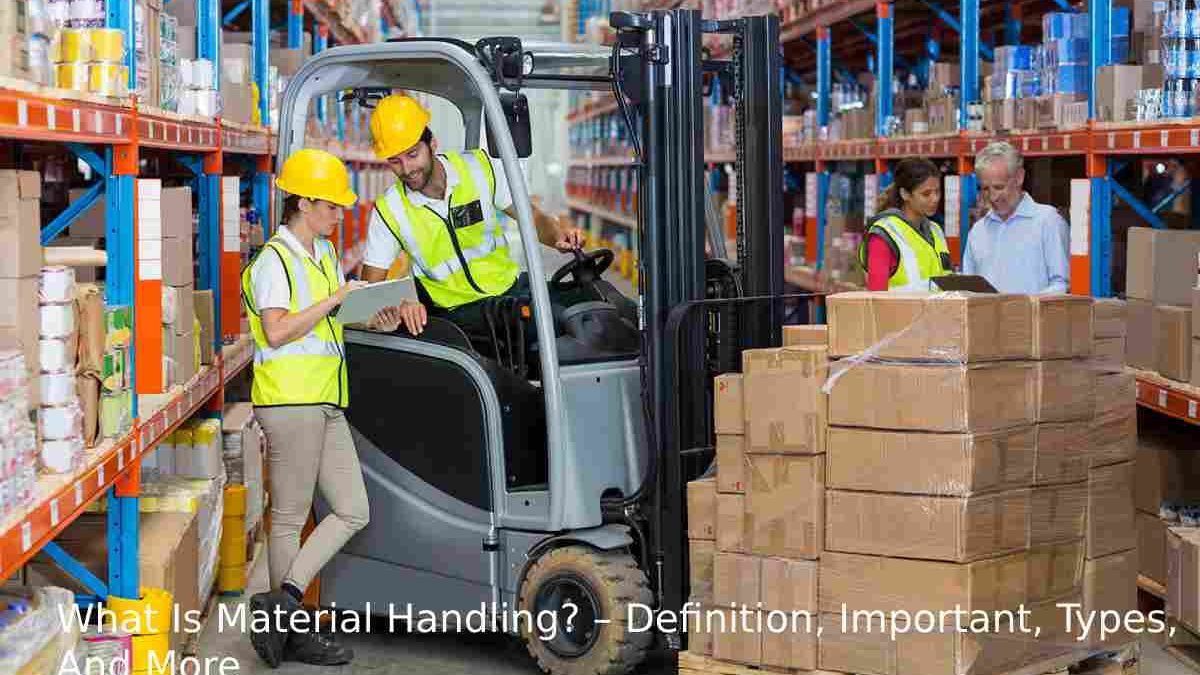
Material handling is one of the most underestimated yet financially impactful functions in global operations. Whether in a warehouse in the U.S., a manufacturing plant in Germany, or an e-commerce hub in India, how materials move directly affects costs, speed, and customer satisfaction.
At its core, material handling refers to the movement, storage, control, and protection of materials across manufacturing, warehousing, distribution, and disposal stages. Material handling is not just operational—it is a system that determines efficiency, scalability, and profitability.
In fact, inefficiencies in warehousing and handling can significantly inflate operational expenses, with global warehousing costs reaching hundreds of billions annually, and many companies still lacking clarity on their true cost structures, as highlighted in McKinsey’s analysis on warehousing costs
Table of Contents
Why Material Handling Matters Globally
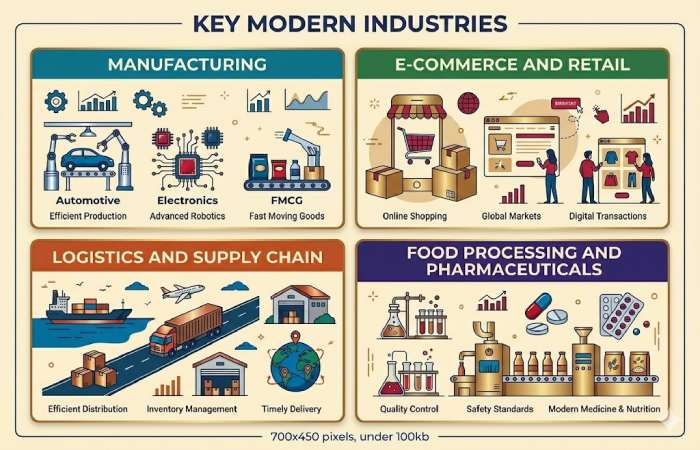
Material handling impacts nearly every industry:
- Manufacturing (automotive, electronics, FMCG)
- E-commerce and retail
- Logistics and supply chain
- Food processing and pharmaceuticals
Globally, warehousing operations cost businesses hundreds of billions annually, driven largely by handling inefficiencies.
More importantly:
- Material handling can account for 20–50% of operational costs in some industries
- Order picking alone can consume up to 50% of warehouse costs
This makes it one of the highest ROI optimization areas.
Core Functions of Material Handling
Material handling is built on four foundational functions.
| Function | Description | Example |
| Movement | Transporting materials | Conveyor belts moving packages |
| Storage | Holding materials until needed | Pallet racks in warehouses |
| Control | Tracking and managing flow | Barcode systems, WMS |
| Protection | Preventing damage | Packaging, climate control |
These functions work together to ensure smooth, efficient flow of goods across systems.
Types of Material Handling Systems
Material handling systems vary based on scale, industry, and investment capacity.
| Type | Description | Cost Level | Best Use Case |
| Manual | Human labor-based | Low | Small businesses |
| Semi-automated | Machines + human input | Medium | Growing warehouses |
| Automated | Minimal human involvement | High | Large-scale operations |
| Integrated (Smart) | AI + IoT + automation | Very High | Global enterprises |
Automation is growing globally, but semi-automation still dominates in developing markets due to cost constraints.
Material Handling Equipment
Material handling relies heavily on tools and equipment.
1. Transport Equipment
| Equipment | Function | Industries |
| Forklifts | Lift and transport pallets | Warehousing, manufacturing |
| Conveyors | Continuous movement | E-commerce, airports |
| Cranes | Heavy lifting | Construction, shipping |
| AGVs (Automated Guided Vehicles) | Autonomous transport | Advanced logistics |
2. Storage Equipment
| Equipment | Purpose | Benefit |
| Pallet racking | Vertical storage | Space optimization |
| Shelving | Small item storage | Easy access |
| Mezzanine floors | Extra storage level | Cost-effective expansion |
3. Control Tools
Material handling equipment is essential because manual handling alone cannot scale efficiently.
| Tool | Role | Impact |
| Barcode systems | Inventory tracking | Accuracy |
| RFID | Real-time tracking | Visibility |
| WMS (Warehouse Management System) | System control | Efficiency |
Material Handling Charges
Material handling costs are often hidden but critical. These costs include all expenses related to moving, storing, and preparing goods within a facility.
Cost Components
| Cost Type | Description | % Impact |
| Labor | Workers, operators | 40–60% |
| Equipment | Purchase + maintenance | 10–30% |
| Space | Rent, utilities | 10–25% |
| Materials | Packaging, pallets | 5–15% |
| Damage & Loss | Breakage, errors | Variable |
Material handling costs also include:
- Energy consumption
- Downtime
- Inefficiencies
Even small inefficiencies can lead to thousands of dollars in losses monthly.
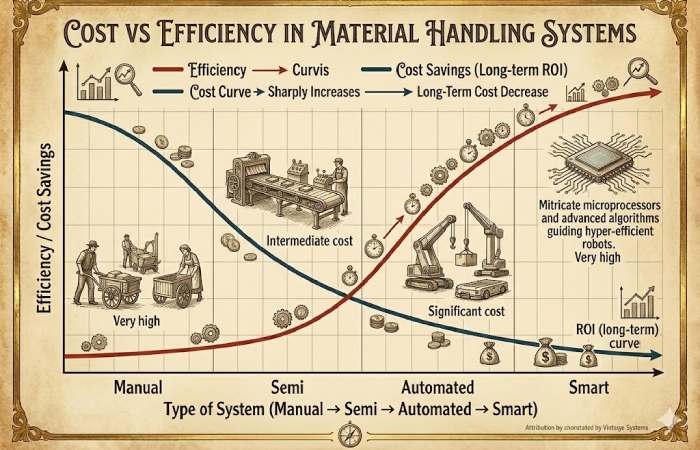
Cost Comparison
| Operation Type | Cost per Unit | Efficiency Level |
| Manual handling | High | Low |
| Semi-automated | Medium | Medium |
| Fully automated | Low (long-term) | High |
- Manual = low upfront, high long-term cost
- Automation = high upfront, low long-term cost
Cost vs Efficiency in Material Handling Systems
Material Handling vs Alternatives
Material handling is not the only approach—there are alternatives or variations depending on business models.
| Approach | Description | Limitation |
| Traditional handling | Manual + basic tools | Inefficient at scale |
| Outsourced logistics (3PL) | Third-party handling | Less control |
| Just-in-Time (JIT) | Minimal storage | High risk if disrupted |
| Dropshipping | No storage required | Lower margins |
Material handling systems are essential even when outsourcing, because 3PL providers rely on advanced handling systems internally.
Locations Where Material Handling is Critical
Material handling is not limited to warehouses.
| Location | Role |
| Warehouses | Storage and distribution |
| Manufacturing plants | Production flow |
| Ports and shipping yards | Bulk material movement |
| Airports | Baggage and cargo handling |
| Retail distribution centers | Order fulfillment |
In global logistics hubs like:
- China (manufacturing)
- USA (distribution)
- Germany (industrial automation)
Material handling systems are highly optimized and often automated.
Material Handling Process Flow
Understanding the flow helps identify inefficiencies.
| Stage | Activity |
| Receiving | Unloading goods |
| Put-away | Storing items |
| Storage | Holding inventory |
| Picking | Selecting items |
| Packing | Preparing orders |
| Shipping | Dispatching goods |
Every stage involves movement and handling costs, making optimization critical.
Key Principles of Efficient Material Handling
| Principle | Meaning | Impact |
| Planning | Pre-designed workflows | Reduced errors |
| Standardization | Uniform processes | Consistency |
| Work minimization | Fewer movements | Cost reduction |
| Ergonomics | Worker safety | Lower injuries |
| Automation | Use technology wisely | Higher productivity |
| Space utilization | Vertical storage | Cost savings |
Common Mistakes Businesses Make
| Mistake | Outcome |
| Poor layout design | Increased travel time |
| Too much manual work | High labor cost |
| Over-automation | Unnecessary investment |
| No data tracking | Poor decision-making |
Benefits of Effective Material Handling
| Benefit | Explanation |
| Reduced costs | Lower labor and waste |
| Faster operations | Improved throughput |
| Better safety | Reduced injuries |
| Scalability | Easier expansion |
| Customer satisfaction | Faster delivery |
Efficient systems reduce delays, damage, and operational errors, improving overall performance.
Future Trends in Material Handling
- Automation & Robotics
- Autonomous mobile robots (AMRs)
- Robotic picking systems
- AI & Data Analytics
- Predictive routing
- Demand forecasting
- IoT Integration
- Real-time tracking
- Smart warehouses
- Sustainability
- Energy-efficient equipment
- Reduced material waste
Bottom Line
Material handling is often treated as a backend function—but globally, it is one of the strongest drivers of operational efficiency and cost control.
- It influences labor, speed, safety, and profitability
- It scales with business growth
- It determines how competitive a supply chain is
The companies that win globally are not just producing better—they are moving smarter.