
The accounting equation is the foundation of modern financial accounting and reporting. Every financial statement—whether prepared under International Financial Reporting Standards or Generally Accepted Accounting Principles—relies on this equation to maintain consistency, transparency, and accuracy.
Globally, more than 140 jurisdictions use IFRS standards for financial reporting, ensuring comparability across markets. At its core, the accounting equation ensures that every transaction recorded in a business is balanced—making it the backbone of double-entry bookkeeping systems used worldwide.
Table of Contents
What Is the Accounting Equation?
The accounting equation is:
Assets = Liabilities + Equity
This equation represents the relationship between a company’s resources, obligations, and ownership.
According to accounting theory, this equation must always remain balanced because every financial transaction affects at least two accounts.
Why the Accounting Equation Matters
Most beginner articles treat the accounting equation as a simple formula. However, in practice, it acts as a financial integrity mechanism. The accounting equation is not just arithmetic—it is a validation system that ensures no financial data is incomplete or misleading.
| Function | Why It Matters |
| Financial Accuracy | Prevents errors in bookkeeping |
| Compliance | Required under IFRS & GAAP |
| Auditing | Detects fraud or inconsistencies |
| Decision Making | Helps evaluate business health |
Components of the Accounting Equation
1. Assets
Assets are economic resources controlled by a business that provide future benefits.
Types of Assets:
| Category | Examples | Global Relevance |
| Current Assets | Cash, inventory | Used for short-term operations |
| Non-Current Assets | Property, machinery | Long-term investments |
| Intangible Assets | Patents, trademarks | Common in tech/global firms |
Assets are essential because they represent a business’s productive capacity.
2. Liabilities
Liabilities are obligations a business owes to external parties.
Types of Liabilities:
| Category | Examples | Time Horizon |
| Current Liabilities | Accounts payable | < 12 months |
| Long-Term Liabilities | Loans, bonds | > 12 months |
Insight:
Leverage (liabilities) can either:
- Boost growth
- Or increase financial risk
3. Equity
The Equity represents the owner’s residual interest after liabilities are deducted.
Equity Breakdown:
| Component | Explanation |
| Capital | Owner investment |
| Retained Earnings | Accumulated profits |
| Dividends/Drawings | Withdrawals |
Expanded Accounting Equation
A more detailed version is:
Assets = Liabilities + Capital + Revenue − Expenses − Drawings
Why This Matters:
| Element | Effect on Equity |
| Revenue | Increases equity |
| Expenses | Decreases equity |
| Drawings | Reduces owner stake |
This connects balance sheet + income statement into one system.
How the Accounting Equation Works
| Transaction | Assets | Liabilities | Equity |
| Investment ₹1,00,000 | +100,000 | 0 | +100,000 |
| Loan ₹50,000 | +50,000 | +50,000 | 0 |
| Expense ₹10,000 | -10,000 | 0 | -10,000 |
Every transaction keeps the equation balanced—this is non-negotiable in accounting systems.
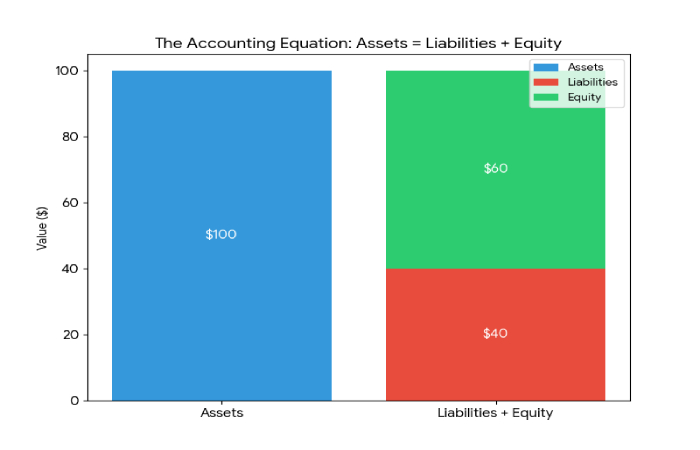
Shows visually how both sides always match despite different transactions.
Specifications of the Accounting Equation
Unlike physical products, the accounting equation has conceptual “specifications” defined by global frameworks.
| Specification | Description |
| Universality | Used globally across industries |
| Structure | Dual-sided balance |
| Framework Compatibility | IFRS, GAAP compliant |
| System Type | Double-entry accounting |
| Nature | Dynamic (changes with transactions) |
Prices & Cost of Using Accounting Systems
While the equation itself is free, using it in practice involves tools, software, and professionals.
Accounting Software Costs
| Software | Monthly Price (Global Avg) | Use Case |
| QuickBooks | $10–$80 | Small businesses |
| Xero | $15–$70 | SMEs |
| SAP ERP | $100+ per user | Enterprises |
Professional Costs
| Service | Price Range |
| Accountant (Freelance) | $10–$100/hour |
| CPA/Chartered Accountant | $100–$500/hour |
| Audit Services | $1,000–$100,000+ |
Where to Access Accounting Tools
Since the accounting equation is implemented via tools:
| Platform | Where to Access |
| QuickBooks | Official website, app stores |
| Xero | Subscription online |
| SAP ERP | Enterprise licensing |
Comparison With Other Financial Concepts
| Concept | Focus | Difference from Accounting Equation |
| Balance Sheet | Financial position | Based on equation |
| Income Statement | Profitability | Shows performance only |
| Cash Flow Statement | Liquidity | Tracks cash movement |
Alternatives to the Accounting Equation
While there is no direct replacement, related frameworks exist:
| Alternative | Use Case |
| Net Worth Formula | Personal finance |
| Working Capital | Short-term health |
| Cash Accounting | Simpler businesses |
Pros and Cons
Pros
| Advantage | Explanation |
| Universal | Used worldwide |
| Accurate | Ensures balance |
| Simple | Easy to learn |
Cons
| Limitation | Explanation |
| Oversimplified | Doesn’t show operational depth |
| Historical | Based on past data |
| Limited Insight | Needs other statements |
Review
From both academic and practitioner perspectives, the accounting equation is considered:
Strengths:
- Reliable foundation
- Prevents accounting errors
- Enables automation
Real Insight (Community Perspective):
From accounting professionals on Reddit:
“It’s the law which holds all double entry together.”
This highlights its role as a fundamental rule, not just a formula.
Global Use Cases
- Corporate Finance
Used in multinational companies following IFRS.
- Small Businesses
Simplifies bookkeeping and tax compliance.
- Banking & Investment
Helps evaluate financial strength.
FAQs
- What is the accounting equation in simple terms?
It shows that everything a business owns is financed by either debt or owner investment.
- Why must the accounting equation always balance?
Because every transaction affects at least two accounts, ensuring equality .
- What happens if it doesn’t balance?
It indicates an error or fraud in financial records.
- Is the accounting equation used globally?
Yes, it is used across all accounting systems including IFRS and GAAP .
- Can the equation change?
The structure remains the same, but values change with transactions.
- Is it useful for beginners?
Yes—it is the best starting point for learning accounting.
Final Verdict
The accounting equation is the most fundamental concept in accounting—simple in structure yet powerful in application. It acts as the backbone of financial systems worldwide, ensuring accuracy, transparency, and consistency across all transactions. While it may appear basic at first glance, mastering it unlocks a deeper understanding of how businesses operate, grow, and sustain themselves financially. For beginners, it provides clarity; for professionals, it serves as a diagnostic tool for financial health and risk analysis.