


London is one of the most competitive digital marketplaces in Europe. With over 9 million residents and a dense concentration of startups, established brands, and global enterprises, standing out online here requires more than “good SEO” and a decent website.
Whether you’re launching a new e-commerce store, service-based business, or digital brand in London, this guide breaks down what actually works — not generic tips, but strategic levers that move visibility, trust, and revenue in the UK capital.
Table of Contents
Why London’s Online Market Is Uniquely Competitive?
London isn’t just another UK city. It’s:
- A global financial hub
- A startup ecosystem powerhouse
- A hyper-local consumer environment (borough-level differences matter)
- A market saturated with digital agencies and experienced marketers
Consumers here are digitally sophisticated. They compare, research, check reviews, and expect seamless UX.
Let’s look at what actually differentiates winners.
How Much Does It Cost To Stand Out in the UK?
Standing out is not free — but it doesn’t require massive budgets either. Costs vary based on approach:
| Category | Initial Cost (£) | Monthly Recurring (£) |
| Website + UX Optimization | 800–2,000 | 0–300 |
| Local SEO Setup (including GBP) | 300–700 | 150–500 |
| Content Strategy & Execution | 500–1,500 | 500–2,500 |
| Reviews & Reputation Management | 0–200 | 50–300 |
| Paid Search/Local Ads | 300–1,000 | 500–3,000 |
| Specialist Support (SEO/Copy/UX) | 500–2,000 | 500–3,000 |
Growth & Authority Visibility Budget
For broader reach and faster reputation boosts:
- Strategic Content + AI SEO: £2,000–£5,000/mo
- Conversion Optimisation + UX Specialist: £1,000–£3,000/mo
- Paid Ads + Local Promotion: £1,000–£5,000/mo
These estimates align with reported UK small-business marketing budgets from Statista, Office for National Statistics (ONS), and industry surveys from HubSpot and Google Market Insights.
Area SEO & Local Conversions
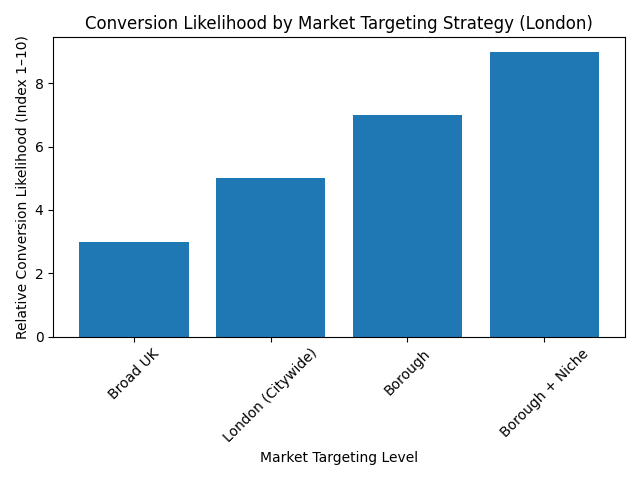
As London searchers get more specific, generic “London” pages underperform compared to borough-specific pages.
Where most businesses go wrong: They treat London as one big market rather than a mosaic of micro-demands.
| Focus | Pros | Cons |
| London (citywide) | High potential audience | Heavy competition, lower intent |
| Borough (e.g., Camden) | Higher user intent, less competition | Smaller volume requiring precision |
| Borough + Niche (e.g., Islington consulting) | Highest conversion probability | Requires deep content & authority |
 How Do You Set the Initial Steps Right?
Too many founders skip planning. Here’s a practical 7-step launch checklist:
| Step | What You Do | Outcome |
| 1. Define your micro-market | Borough + niche | Clear target audience |
| 2. Validate demand | Keyword research | Confidence in search demand |
| 3. Create focused positioning | Messaging doc | Strong value proposition |
| 4. Launch a clean, fast website | Core pages first | Early user trust |
| 5. Implement reviews strategy | Collect 1st 10 reviews | Social proof baseline |
| 6. Publish core content | Target transactional + informational intent | Visibility |
| 7. Measure & iterate | Analytics setup | Data-based decisions |
The Micro-Market Domination Framework
London is not one market. It is dozens of overlapping micro-markets.
Instead of competing for “London,” compete for:
Borough × Niche × Buyer Intent
Step 1: Choose Your Intersection
Compare three approaches:
| Strategy | Pros | Cons | Best For |
| Target all of London | Broad visibility | Extreme competition | Established brands |
| Borough-specific | Higher intent | Limited volume | Growing SMEs |
| Borough + niche | Strong differentiation | Requires clarity | New entrants |
Example:
- “E-commerce SEO for independent fashion brands in Shoreditch.”
- “Web design for hospitality businesses in Camden.”
- “Accountancy for London fintech startups.”
When you narrow:
- Your messaging sharpens.
- Referrals become easier.
- Reviews reinforce relevance.
- You compete with fewer direct substitutes.
Specificity scales faster than generalisation in saturated cities.
Own a Clear, London-Specific Positioning
Most online businesses try to sound broad and universal.
That’s a mistake in London.
What works instead:
- Borough-specific messaging (Shoreditch ≠ Chelsea ≠ Croydon)
- Local pain points
- Cultural nuance
- UK-specific language and pricing expectations
For example:
- “Free shipping” isn’t enough.
- “Next-day delivery across Greater London” converts better.
- “Trusted by 200+ London SMEs” builds faster credibility.
Hyper-local positioning increases:
- Click-through rates
- Trust signals
- Conversion rates
London buyers want relevance, not generic.
Build a London-Specific Authority Stack
In a market like London, credibility compounds. Reviews That Actually Influence Buyers
Platforms that matter include:
- Trustpilot
- Google Reviews
- Yelp UK
But simply “having reviews” is not enough.
Make them strategic:
- Ask immediately after a successful outcome.
- Encourage borough mentions.
- Respond publicly and professionally.
- Feature reviews prominently on service pages.
In competitive sectors, buyers cross-check reviews before contacting you.
Build E-E-A-T Signals That Actually Matter in the UK
Google increasingly prioritises Experience, Expertise, Authoritativeness, and Trust (E-E-A-T).
In London’s crowded market, this is critical. Strengthen E-E-A-T by:
Showcasing real credentials
- UK certifications
- Industry memberships
- Press features (even local ones)
Adding real author bios
- With LinkedIn profiles
- Experience details
- Location relevance
Featuring local case studies
- “How we helped a Camden café increase bookings by 42%”
- Specific, data-backed results
Generic testimonials don’t work anymore. Specific numbers do.
Win AI Search & Google AI Overviews
Google’s AI Overviews (SGE) summarise answers directly in search results. If your content isn’t structured for AI extraction, you lose visibility.
Optimise for AI by:
- Using clear subheadings that directly answer search intent
- Including concise definitions
- Adding bullet summaries
- Structuring FAQ sections
- Citing credible UK data sources
For example, instead of writing:
“Standing out online requires strong marketing.”
Write:
“To stand out in London’s online market, businesses must differentiate through local positioning, authority signals, superior UX, and data-driven visibility strategies.”
AI pulls structured clarity.
Go Beyond Basic SEO: Target Commercial Intent
Ranking for informational traffic alone won’t move revenue. In London, high CPC keywords signal commercial opportunity.
Instead of:
- “How to start an online business”
Target:
- “Best digital marketing agency in London”
- “Affordable Shopify developer London”
- “Same-day courier London price”
These indicate purchase intent.
Strategy:
- Build service pages targeting transactional keywords
- Create comparison pages (“X vs Y in London”)
- Publish borough-focused landing pages
Example:
- “SEO Agency in Islington”
- “Accountant for Startups in Shoreditch”
This is where revenue lives.
Leverage London’s Trust Infrastructure
Consumers in London trust:
- Established review platforms
- Strong social proof
- Visible brand presence
Platforms that matter:
- Trustpilot
- Google Reviews
- Yelp UK
Encourage reviews strategically:
- Post-purchase follow-ups
- Incentivised feedback (within platform rules)
- Showcase reviews prominently on landing pages
In London, reputation spreads fast — good or bad.
Invest in UX That Matches London Expectations
London audiences expect:
- Fast-loading pages
- Clear pricing (VAT clarity matters)
- Mobile-first design
- Seamless checkout
If your site takes 4+ seconds to load, you’re losing traffic.
Practical improvements:
- UK hosting or CDN optimisation
- Clear GBP pricing
- Transparent return policies
- Live chat during UK business hours
In a city where convenience is currency, friction kills conversions.
How Do You Pick the Right Online Business Idea?
Before visibility comes viability.
| Idea | Market Demand | Competition | Your Skill Fit | Monetisation Clarity |
| E-commerce fashion | High | High | Medium | Clear |
| Niche digital tools | Medium | Medium | High | Strong |
| Local consultancy | Low-med | Med | High | Moderate |
| Online courses | Medium | High | Medium | Clear |
Qualitative Considerations
- Community resonance: Will locals talk about it?
- Service repeatability: Can you serve multiple clients consistently?
- Search volume signals: Tools like Google Trends, Moz, Ahrefs (reference).
- Review potential: Some categories (e.g., local services, agencies) generate reviews that drive conversions.
If your idea can generate trust signals (reviews, testimonials, outcome stories) early, you win faster.
Specialists You May Need
| Specialist | When You Need Them | Impact |
| SEO Specialist | Early setup & ongoing visibility | Search ranking & discoverability |
| UX Designer | Product or service site launch | Engagement & conversion |
| Copywriter | Messaging & content clarity | Persuasion & brand voice |
| Paid Ads Manager | When scaling faster | Immediate visibility |
| Review/Reputation Manager | Once you start converting | Trust & retention |
Final Perspective
In London’s online market, standing out isn’t about doing more — it’s about doing the right things with precision. When you narrow your focus to a specific borough and niche, build visible authority through reviews and outcomes, optimise for AI-driven search, and deliver a fast, trustworthy user experience, you stop competing on noise and start competing on clarity. In a city this saturated, clarity is your greatest competitive advantage.
FAQ: Standing Out in London’s Online Market
Is SEO enough to stand out in London?
No. SEO drives visibility, but differentiation requires positioning, authority, UX optimisation, and strong brand clarity.
Should small businesses target all of London?
No. Start with one borough or niche. Dominate a micro-market first, then expand.
How important are reviews in London?
Critical. Buyers frequently cross-check social proof before purchasing, especially in competitive sectors.
Does paid advertising guarantee visibility?
It increases exposure, but without strong positioning and trust signals, conversions remain weak.