
Small accounting firms are not disadvantaged in tenders by default. When procurement scoring, specialization, and service design are understood, small firms often have structural advantages over large generalists.
Many small firms assume tenders are built for national providers with deep benches and brand recognition. That assumption causes capable specialist firms to self-exclude before they ever read the scoring criteria. The result is missed access to multi-year contracts, framework panels, and institutional clients.
Small firms should compete for accounting tenders because most tenders are scored on relevance, method, risk controls, and evidence — not firm size — and small specialist firms often outperform large generalists on those dimensions.
This guide is written for small and mid-size accounting practices evaluating whether tendering is worth the effort. It explains where small firms win, where they lose, how scoring actually works, and how to decide rationally.
Table of Contents
Why the “Tenders Are for Big Firms”?
The belief persists because visible winners are often large firms, and marketing from major networks dominates search results. But procurement evaluation is usually structured and weighted, especially in public and institutional buying environments influenced by guidance from bodies like the World Bank and national procurement authorities.
Small firms don’t usually lose because they are small. They lose because they submit generic, under-evidenced responses or bid for poor-fit scopes.
How to Calculate Tender Price
In cost accounting, the tender price is the estimated total cost plus a profit margin.
Formula: Tender Price = Prime Cost + Factory Overheads + Office & Admin Overheads + Desired Profit
- Prime Cost: Direct materials + direct labor + direct expenses.
- Overheads: Usually calculated as a percentage of direct wages (for factory) or works cost (for office) based on past records.
Live Accounting & Audit Tenders
| Tender Title | Location | Scope | Estimated Bid Value | Deadline / Due Date | Source |
|---|---|---|---|---|---|
| Prequalifications for Audit & Accounting Services | Central Africa | Panel of providers for audit & accounting | Not published | 20 Feb 2026 | BidDetail (global listing)(Bid Detail) |
| Procurement Plan for Audit Services | Micronesia | Audit services procurement plan | USD 130,354 | 31 Mar 2026 | BidDetail – CPV 79210000 |
| Audit of Project Accounts (SBEE) | Western Africa | Financial audit services | USD 109,222 | 08 Aug 2026 | BidDetail – CPV 79210000 |
| Financial Audit Services — SW Delhi | India (Delhi) | Financial audit; CA firm | ₹667,000 | 23 Dec 2025 | TenderDekho India listing |
| Financial Audit / Internal Audit — New Delhi | India (Delhi) | Internal audit services | ₹700,000 | 06 Jan 2026 | TenderDekho India listing |
| Financial Audit Services – North Bengal Wild Animals Park | India (West Bengal) | Accounting & audit services | ₹168,000 | 13 Feb 2026 | TenderDetail India accounting audit tenders |
| Centralised Energy Accounting & Audit | India (Delhi) | Centralised audit & accounting cell | ₹14,800,000 (1.48 Cr) | 06 Mar 2026 | TenderDetail India accounting audit tenders |
| District Textbook Board Accounting & Audit | India (Rajasthan) | Audit & physical verification | ₹10,000 | 01 Dec 2025 | TenderDetail India accounting audit tenders |
| Internal Audit & PFMS Support | India (Maharashtra) | Internal audit & systems support | Not published | 13 Feb 2026 | TenderDetail financial audit list(tenderdetail) |
| Hiring Internal Auditor — Kamrup Metro | India (Assam) | Concurrent internal audit | ₹5,700,000 | 06 Feb 2026 | TenderDetail financial audit tenders |
Where to Track More Live Accounting Tenders
| Platform | Coverage | Why Use It |
|---|---|---|
| Tender Impulse | Global | Aggregates accounting tenders from 240+ countries and procurement sources. |
| BidDetail | Global | Lists hundreds of live accounting and audit opportunities worldwide. |
| TenderDetail / Tendersniper | India & regional | Search by category (accounting & audit), location, deadlines. |
| National eProcurement Portals | Country-specific | Official source for government tenders (e.g., India’s CPPP, UK Find a Tender, EU TED) |
Government Accounting Tender Eligibility Requirements – Global/Public Sector
| Eligibility Requirement Category | What It Means | Typical Conditions / Examples |
|---|---|---|
| Legally Valid Business Entity | Must be a registered company/firm | Sole proprietorship, LLP, Pvt Ltd, partnership, etc., registered with relevant authority. Proof needed (certificate of incorporation). |
| Tax & Regulatory Compliance | Tax/legal registrations must be current | Valid PAN, GSTIN, tax clearance, EPF/ESI (if required), no tax defaulters. |
| Procurement Portal Registration | Must be registered where the tender is published | e.g., CPPP, GeM (India), SAM.gov (US), TED (EU). DSC (Digital Signature Certificate) often required for e-bids. |
| Financial Capacity | Proof of financial stability | Minimum average annual turnover (e.g., last 3 years), positive net worth, audited financials — may require solvency certificate. |
| Past Experience / Technical Capacity | Shows ability to execute accounting work | Completion certificates or work orders for similar services in last 3–5 years, often with minimum value thresholds. |
| Turnover / Profit Requirements | Ensures bidder can handle project size | Some tenders require turnover equal to or above a percentage of tender value for previous years. |
| Documentation Completeness | All required docs must be uploaded | Company docs, financials, experience proofs, declarations, EMD/Bid security proof — missing docs often cause disqualification. |
| No Blacklisting / Ethical Clearances | Good legal standing | Declaration that the firm is not blacklisted or debarred by any government agency. |
| Work Completion Proof | Experience must be verified | Work completion certificates from clients (not just invoices) showing deliverables were met. |
| Consortium/JV Requirements (if allowed) | If bidding as a consortium | Lead partner meets a portion of criteria; roles & agreements must be documented. |
| Personnel / Resource Capability | Demonstrate staffing to do the work | Especially in service contracts: qualified accountants, technical leads, or managers must be listed. |
| Additional Certifications (if specified) | Optional but beneficial | ISO certification, quality standards, MSME/Udyam registration for preference — not always mandatory but useful. |
Notes on These Eligibility Criteria
-
Technical bids are evaluated first: Documents proving eligibility are reviewed before financial bids — failure to meet any can lead to technical disqualification.
-
Financial requirements vary widely: Smaller contracts may ask for modest turnover, while larger tenders (especially in US/EU) may have high thresholds or solvency ratios.
-
Experience must be similar work: Tender notices often define what counts as “similar” — for accounting tenders, that typically means audit, financial reporting, bookkeeping, compliance work, or consultant roles — not unrelated services.
-
Document completeness is vital: Incomplete submission — even if your firm is qualified — is one of the top reasons bids are rejected.
Common Documents You’ll Need to Prove Eligibility
| Document Type | Purpose |
|---|---|
| Business Registration Certificate | Proves legal entity |
| PAN / Tax IDs & GST | Regulatory compliance |
| Audited Financial Statements | Shows financial health |
| Turnover / Solvency Certificates | Financial capacity proof |
| Work Orders & Completion Certificates | Past experience evidence |
| Bid Security (EMD) Proof (if required) | Ensures seriousness |
| DSC / eBid Authentication | Required for online submission |
| Non-Blacklisting Declaration | Legal and ethical standing |
Tender Team for Small Accounting Firms
| Role / Professional | Mandatory or Optional | What They Contribute in Tender | Why Evaluators Care | Small-Firm Strategy |
|---|---|---|---|---|
| Engagement Partner / Lead CA / CPA | Mandatory | Overall accountability, sign-off authority | Shows senior oversight & responsibility | Name partner directly in bid |
| Tender / Bid Manager | Highly Recommended | Manages RFP response, compliance matrix | Prevents disqualification errors | Can be part-time or outsourced |
| Technical Accounting Lead | Mandatory | Methodology, standards, reporting approach | Scores technical section | Use your niche specialist |
| Audit / Assurance Specialist | If audit scope | Audit framework & risk approach | Required for audit tenders | Use certified auditor profile |
| Tax Specialist | If tax scope | Tax compliance & advisory method | Adds subject credibility | Add as named expert |
| Quality Assurance Reviewer | Recommended | Independent review process | Reduces delivery risk | Use external reviewer if needed |
| Compliance & Controls Advisor | Recommended | Internal controls & risk mapping | Important in public contracts | Fractional consultant OK |
| Data / Systems Accountant | If digital scope | ERP, cloud, automation workflows | Shows scalability | Highlight software expertise |
| Project Manager | Recommended | Delivery timelines & milestones | Execution reliability | Combine with senior accountant |
| Information Security Lead | If handling sensitive data | Data protection & confidentiality | Critical in gov tenders | Use policy + named lead |
How Accounting Tender Actually Works
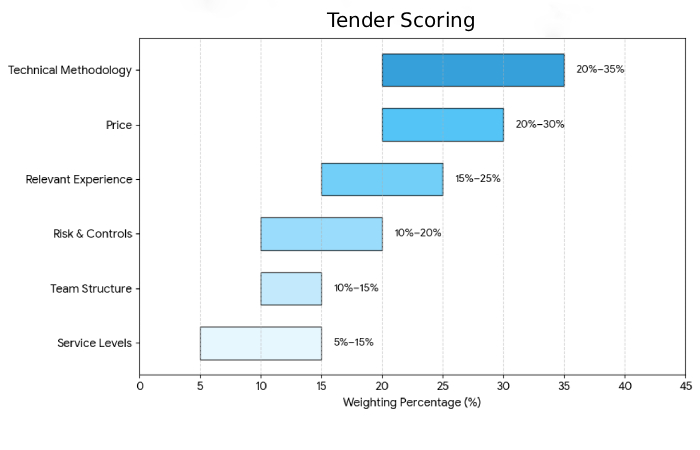
Most accounting tenders use weighted criteria. Scores are assigned per section, then totaled. Brand alone is rarely a scoring line item.
Tender Scoring Model (Illustrative)
| Evaluation Area | Typical Weight Range | What Evaluators Look For | Small Firm Advantage Lever |
|---|---|---|---|
| Technical Methodology | 20–35% | Clear delivery steps | Documented workflow |
| Relevant Experience | 15–25% | Sector similarity | Niche case studies |
| Risk & Controls | 10–20% | QA, security, continuity | Named oversight |
| Team Structure | 10–15% | Roles & accountability | Partner involvement |
| Service Levels | 5–15% | SLAs, reporting | Custom models |
| Price | 20–30% | Value vs cost | Lean overhead |

Why Smaller Accounting Firms Are Landing Government Contracts
| Driver | What Changed in Government Procurement | Why It Favors Smaller Accounting Firms | What Evaluators Actually See | How Small Firms Capitalize |
|---|---|---|---|---|
| SME participation mandates | Many governments track SME supplier spend | Buyers are encouraged to award to qualified small firms | SME status counts positively in supplier mix goals | Register as SME and highlight classification |
| Weighted scoring models | Contracts scored on method + relevance, not brand | Technical responses outweigh firm size | Detailed methodology earns points | Submit process maps and delivery workflows |
| Specialization demand | More sector-specific accounting needs | Niche firms show higher relevance | Sector case studies score higher | Focus on vertical expertise (grants, healthcare, education) |
| Framework contracting | Multi-supplier frameworks common | Panels include firms of different sizes | Work is distributed across panel | Win framework spot first, compete later |
| Cost efficiency pressure | Budget scrutiny increased | Lean firms price efficiently | Value scoring rewards cost-quality balance | Show efficiency model, not just low price |
| Named team scoring | Bids scored on assigned personnel | Small firms offer stable named teams | Continuity reduces delivery risk | Name partner + delivery lead |
| Digital delivery acceptance | Remote accounting widely accepted | Geography matters less | Tool stack reduces scale concerns | Document cloud & workflow tools |
| Risk diversification | Buyers avoid single mega suppliers | Smaller suppliers reduce concentration risk | Multi-vendor strategy preferred | Position as specialist complement |
| Shorter contract lots | Contracts broken into smaller lots | Lotting lowers scale barrier | Smaller lots = realistic capacity fit | Bid only matching lots |
| Compliance templates | Standardized bid formats | Levels playing field | Structured answers scored equally | Follow structure precisely |
Where Small Accounting Firms Score Higher Than Large Firms
Small firms tend to win on specificity, continuity, and adaptability.
| Criterion | Large Generalist Pattern | Small Specialist Pattern | Likely Score Outcome |
|---|---|---|---|
| Sector relevance | Broad mixed clients | Deep niche focus | Small firm higher |
| Delivery continuity | Rotating staff | Fixed team | Small firm higher |
| Customization | Standard model | Tailored | Small firm higher |
| Process clarity | Framework-driven | Step-mapped | Depends on documentation |
| Brand comfort | High | Moderate | Large firm slight edge |
| Price flexibility | Lower | Higher | Small firm edge |
Depth beats breadth in scored environments.
Products & Tools That Strengthen Small-Firm Tender Bids
Small firms can offset size concerns with tooling and process platforms. Instead of claiming “we are efficient,” show your stack.
Common Accounting & Tender-Support Tools
| Category | Example Products | Use in Tender Context | Pricing Model (Typical) | Online / Offline |
|---|---|---|---|---|
| Cloud accounting | Xero | Workflow efficiency proof | Subscription | Online |
| Cloud accounting | QuickBooks | Volume handling | Subscription | Online |
| Practice mgmt | Karbon | Capacity tracking | Per-user | Online |
| Audit workflow | CaseWare | Audit controls | License | Hybrid |
| Doc controls | Microsoft SharePoint | Evidence mgmt | Subscription | Online |
Pricing varies by region and seat count — editor should insert current ranges from vendor pages.
Where Small Firms Win Most Often
Win probability varies by tender type.
Tender Type Fit Matrix
| Tender Type | Scope Complexity | Scale Need | Small Firm Fit | Notes |
|---|---|---|---|---|
| Sector specialist | Medium | Low | High | Niche advantage |
| Regional framework | Medium | Medium | High | Relationship value |
| Advisory projects | High | Low | High | Expertise wins |
| Bulk processing | Low | High | Low | Scale wins |
| National mega lots | Very high | Very high | Low | Consortium needed |
Selective bidding is a strategic advantage.
Example Bid/No-Bid Decision
| Question | Yes | No | Action |
|---|---|---|---|
| Strong sector match? | Yes | Continue | |
| Capacity proven? | Yes | Continue | |
| Case studies ready? | Yes | Continue | |
| Margin viable? | Yes | Continue | |
| Scale exceeds team? | Yes | Decline |
Specialist Roles That Increase Small Firm Competitiveness
Tender evaluators score named expertise.
High-Impact Named Specialists
| Specialist Role | Why It Scores | Small Firm Strategy |
|---|---|---|
| Engagement partner | Accountability | Name & commit |
| QA reviewer | Risk control | External advisor |
| Data security lead | Compliance | Fractional expert |
| Sector advisor | Relevance | Niche consultant |
Using fractional specialists is acceptable when disclosed clearly.
Pricing Strategy — Value vs Underpricing
Small firms often lose by underpricing instead of explaining efficiency.
| Pricing Approach | Evaluator Perception | Risk | Better Alternative |
|---|---|---|---|
| Lowest price | Risky quality | Margin loss | Value-justified |
| Mid + evidence | Balanced | Moderate | Best |
| High + proof | Premium | Scrutiny | Works if niche |
Procurement guidance from institutions like the OECD emphasizes value scoring over lowest cost.
Reviews & Credibility Signals Evaluators Accept
Tender evaluators do not rely on public star ratings alone — they prefer structured references.
| Evidence Type | Accepted in Tenders | Source |
|---|---|---|
| Client references | Yes | Direct |
| Case studies | Yes | Internal |
| Audit reports | Often | Regulator |
| Certifications | Yes | ISO bodies |
| Online reviews | Rarely scored | Public sites |
Public reviews help marketing but formal references win tenders.
Risks Small Firms Must Acknowledge
Tendering is not free growth.
| Risk | Reality | Mitigation |
|---|---|---|
| Time cost | High first bids | Template library |
| Compliance burden | Real | Pre-audit controls |
| Overcommitment | Dangerous | Capacity caps |
| Cash flow delay | Possible | Contract terms review |
Final Position
Small firms should compete for accounting tenders — not blindly, but strategically — because scoring systems reward relevance, clarity, and proof more than size. When specialization, tooling, and risk controls are documented, small firms often become lower-risk choices, not higher-risk ones.